Content Aggregation and Automation System: The Case of Lost Hours
Discover how to identify tasks ready for automation to enhance efficiency.

My Role: Automation Architect and Developer
Project Description
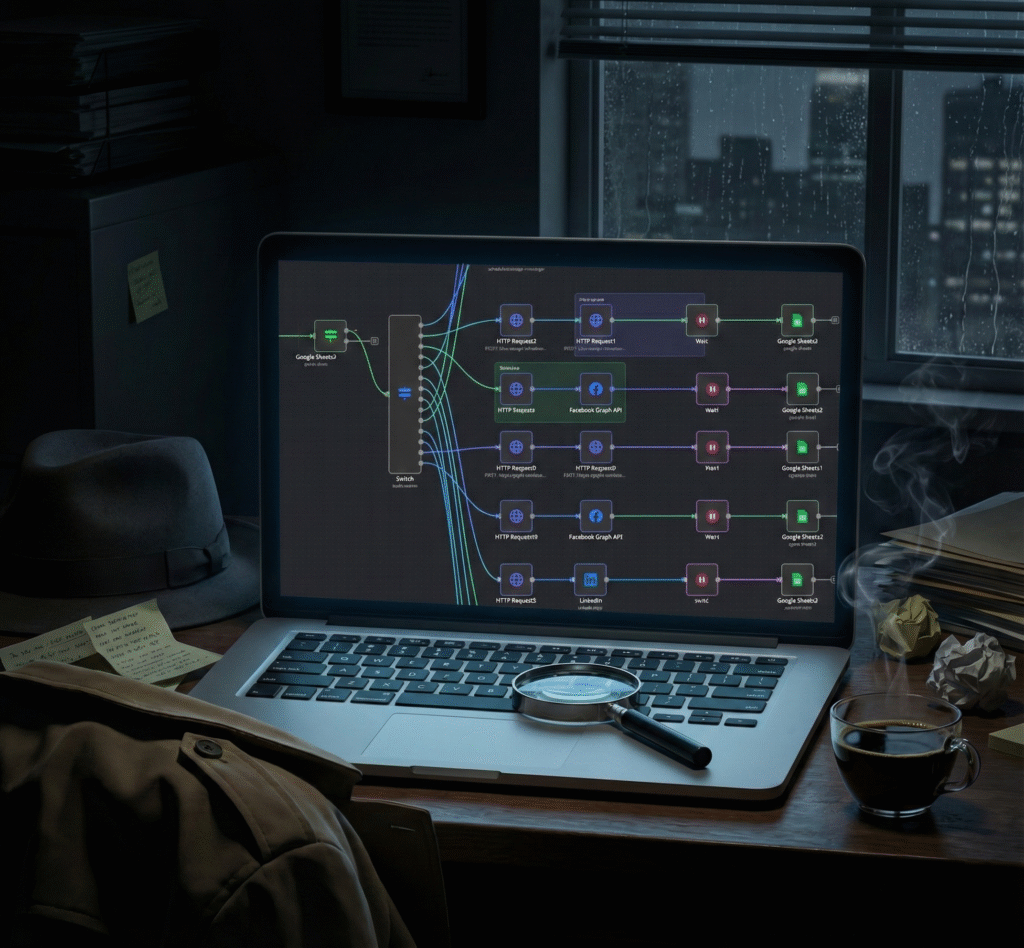
We automated the entire news publication workflow—from web scraping and topic filtering to drafting posts and gathering engagement statistics. Now, the bot finds relevant news, verifies it with AI, drafts posts, generates images, and even reports errors. Human involvement is now only required for content review and approval. As a result, the team reduced daily work time from 3.5 hours to just 30 minutes—saving almost a whole workday each week. 🥂
Tools
n8n | Automation | API | Marketing Operations and Workflows
Client
Internal marketing department of a medium-sized company.
Task
The team initially approached me with a request for post automation. After analyzing the process, we realized that much more could be automated—everything that occurs before publication: from searching for references and creating content to preparing it for posting. As well as after publication—up to collecting view statistics.
Challenge:
- Every news site had a different structure—some had RSS feeds, some did not, complicating parsing.
- It was necessary to filter news by topic relevance.
- Content creation still required human involvement.
- Each platform had its own API, which consumed a significant portion of development time.
- Some services had API keys with expiration dates that needed careful management.
Solution:
The process is almost entirely human-free.
- Each morning, the bot starts, scrapes news from selected sites, and checks them against keywords.
- If a news item is suitable, the neural network confirms it, and the storyline is automatically added to the table. This creates a fresh list of relevant news each morning.
- Then, a human selects the necessary items, and the bot writes a post based on a custom prompt and generates an image.
- After a quick review and edits, the text is sent to the next agent, who instantly publishes it across all social media platforms.
- If an error arises, the bot reports it directly to the messenger.
- At the end of the day, it gathers view and engagement statistics from Telegram, LinkedIn, Instagram, and Facebook.
Now, human involvement in the process occurs only twice—to select and approve content—while everything else is fully automated.
Result
- Previously, the team spent about 3.5 hours a day: 30 minutes for searching, 1.5 hours for writing, and another 1.5 hours for publishing.
- Now, the entire process takes only 30 minutes a day.
- A full week previously required about 25 hours of work, now it takes only 3.5 hours.
Conclusion with Key Findings
It’s a huge difference—the team has freed up almost an entire workday. Why not celebrate automation with a small party? 🥂 Cheers!